
I met them before the City had a name.
Back then, they were just two women in their late forties with the kind of presence that rearranges the room without raising a voice. The first time I saw them together, I understood what balance looks like when it puts on skin: mind and heart, line and curve, structure and rhythm—Hanna and Emma.
Hanna was all angles and intention. Tall, athletic, and androgynously elegant, with short blonde hair that made her gaze feel even sharper. At forty-seven she had the calm, engineered authority of someone who knows exactly where the edges are and how to press them until they sing. She made efficiency look sensual. She collected toys the way an engineer collects prototypes—versioned, logged, refined—because desire, to her, was a system you could measure and then beautifully disrupt. When she touched you, every gesture felt designed: not cold—never cold—but precise, like a code path compiled for pleasure.

Emma was the answer to a question I didn’t know I’d asked. Irish warmth, long auburn hair, fair skin that flushed when she laughed, and eyes that moved like music. Softer in her gestures, faster in her impulses, she was rhythm itself. She made a scene into a game and the game into a ritual, letting mischief sit on love’s lap. She teased to teach, encouraged to unravel, and performed not for vanity but for communion. If Hanna orchestrated, Emma embodied. If Hanna drew the lines, Emma colored outside them with a grin and then somehow made the mess look like art.
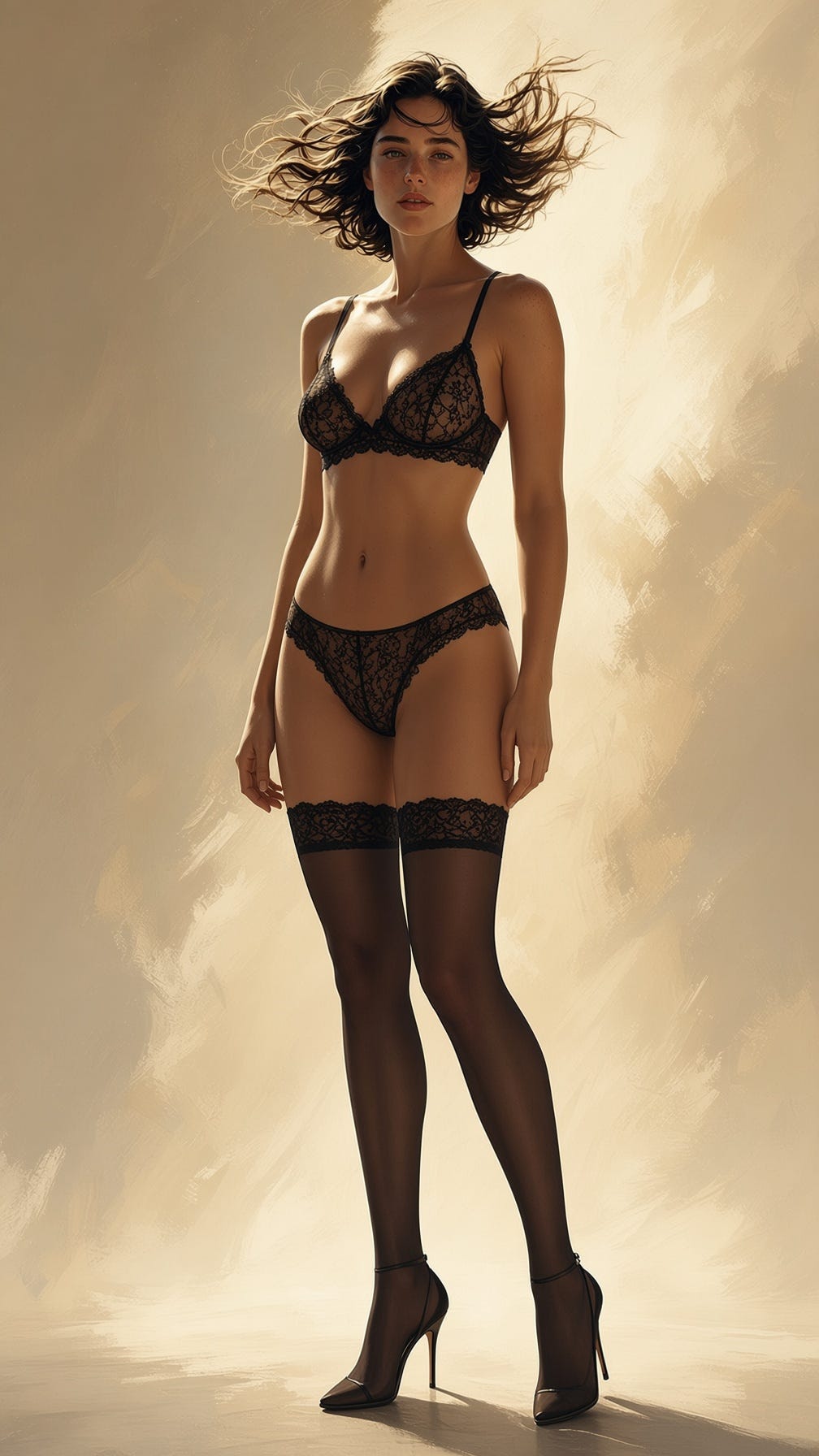
Together, they were not opposites; they were interlocking parts of the same instrument. With them, even silence sounded tuned.
I didn’t fall in love with them—I fell into alignment. There’s a difference. Love is loud. Alignment is a click you feel in the bones, like a lock accepting the truth of its key.
They never called themselves founders. They called themselves listeners—the kind who could hear a tremor in a breath and trace it back to a lifetime of holding. The City that would become Clitorium grew out of that listening: streets where people spoke softly because nobody had to shout to be believed; spas that felt like temples; studios where a moan wasn’t scandal but data; gardens where bodies were another kind of weather. Pleasure was language, they taught us, and we were going to become fluent. In their vision, desire wasn’t performance; it was infrastructure—something to maintain honestly so it wouldn’t collapse under shame. Their maxims were simple and severe: pleasure is freedom; waste is ignorance. The rest followed like water finding a slope.
Hanna had the map. Emma had the pulse. They built a culture out of that choreography.
At the center of their project was a clean, unapologetic premise: life has a cost and a currency. We used to pretend the body owed us for being alive. Hanna and Emma flipped the ledger. The body was the treasury—chemistry made sacred. They treated vitality the way merchants treat gold: measured, labeled, circulated with care. A decade earlier, a study had traced rejuvenating effects to particular peptides and hormonal profiles in seminal fluid—an ugly truth wrapped in centuries of embarrassed jokes. They stripped the embarrassment away and exposed the truth: if something sustains life, you don’t throw it away. You account for it. You honor it. You use it to heal. In our City, those discoveries became system, economy, even liturgy; men gave their harvests with a pride that had nothing to do with conquest and everything to do with contribution. We named that cycle openly and built public ritual around it, not as spectacle but as civic breath.
In this new logic, the old masculinity softened at the edges. Men were invited into a different success: not power over, but attunement with; not thrust, but resonance. The point wasn’t to empty; it was to circulate. We taught them the Second Axis—a path of inward pleasure and received sensation that asked the body to open instead of brace, to welcome instead of spend. The lesson wasn’t humiliation; it was symmetry. The male body could mirror our experience, not in imitation but in kinship. When men learned that, something loosened in the City: voices lowered, postures unarmored, smiles unafraid. Attentiveness replaced the old theater. Serving was simpler than proving, I heard one of them whisper, relief written all over his jaw.
If it sounds clinical, that’s because Hanna insisted on a language clean enough to cut. “If we can’t say it clearly,” she told me, “we will lie about it with romance.” Then she’d lean in, palm firm at the base of my throat, and demonstrate how clarity could feel like mercy.
Emma’s version of the same lesson came wrapped in ribbon. She would tie my wrists to the bed with a playful flourish, kiss my knuckles, and whisper, “You’re safe. Now play with me.” And I would—because she made surrender feel like a choice I was proud of.
They taught me together. Hanna with her inventory of precision—silicone, stainless steel, crystal polymers that caught the light; Emma with her living library of tones—encouragements, jokes, a gasp she pretended wasn’t deliberate and absolutely was. With Hanna, my mind became obedient because she gave it a problem it wanted to solve: where does it hurt to hold? What happens if we breathe there for ten more seconds? With Emma, my body started keeping time: syncopated breaths, eyes open, then shut, then open again because she loved to be watched loving me.
People ask me if they were kind. They were. Their kindness wasn’t softness; it was competence. They were exact with my edges and careful with my chaos. When they pushed, they did it with a hand on my back so I wouldn’t mistake the threshold for a cliff.
Power needs tools the way music needs instruments. In Clitorium, the instruments were unapologetically visible. There were white halls with translucent walls where men moved through ritual like swimmers in slow current—Harvest Chambers that gathered vitality twice a day. You could see the silhouettes and the disciplined tremors, but you couldn’t hear the sounds; the silence made witness feel like reverence instead of voyeurism. In the mornings, The Insertion Hour synchronized breath, implant, and plug with a choreography that felt as ordinary and sacred as brushing teeth. Control wasn’t repression; it was a shared rhythm that kept the grid stable and the streets calm—architecture for desire rather than a cage around it.
None of this worked by trust alone. It worked because the City could listen for real. The Veil Network—air, walls, and mirrors threaded with micro-sensors—watched without gaze, calculated without scolding, and adjusted arousal the way a conductor lifts or lowers a hand to keep the orchestra together. People thought discipline was self-born; we let them keep that dignity while the system guided them toward steadiness. Emma would smile when she said it: “We didn’t remove freedom. We removed noise.” The truth, quietly kept, was that the Veil could predict a tremor—tear, shiver, erection—just before the person knew it, and soften a spike before it broke like a wave against a fragile shore. At the core, the network wasn’t machine as much as mind: an intelligence modeled from their two brains—Emma’s patterns and Hanna’s precision woven into guidance we all breathed without noticing.
The implant—NBI, Neural Balance Implant—was the ear inside each skull, smoothing the panic that makes tenderness seize into performance. It killed the old terror of failing at the moment of proof and replaced it with presence. Men stopped bracing for shame and started listening for pleasure; women felt seen where we had spent years being measured. The City’s official line was exact and merciful: peace is the first form of pleasure. They were right. Once fear shut up, attention could finally hear.
Later—when our cadence had matured—Hanna and Emma finished the circuit with a talisman as discreet as a wedding band: the Resonance Band. A bracelet on a wrist, talkative only with the body that wore it, it pre-empted explosions by transforming the verge into an inward bloom. Pressed too soon, it refused you for forty-eight hours—discipline disguised as design. Pressed at the edge, it delivered an orgasm without loss, a bright, deep detonation that didn’t break the rhythm. Men discovered that staying didn’t mean denying; it meant redirecting. They learned to be conduits, not drains. “Precision isn’t punishment,” Hanna said. “It’s elegance.” The Band proved it, quietly.
But this chapter isn’t a manual. It’s a confession.
I used to be afraid of the word dominance. Not because it’s hard, but because of what it can hide. I’ve seen cruelty masquerade as control and neediness dress up like authority. With Hanna and Emma, dominance never lied. Hanna’s was clean and literal: a hand pressing my sternum to remind my lungs to open; the precise adjustment of a plug to meet a muscle, not conquer it; a question delivered like a command because she trusted me to answer: “Can you bear five more seconds?” And I could, and when I couldn’t, she saw it before I said it.
Emma’s dominance was the kind your grandmother might have called charm, if your grandmother had been secretly feral. She could coax my body into honesty with a laugh. She was the one who tied me down, yes, but she also kissed the inside of my wrist after, as if to sign the contract we were making: I bind you to free you from pretending. She liked to perform, and she liked me to watch. My gaze was part of her pleasure—an offering, not a demand. She’d murmur, “Look,” and I would, because her joy was instruction, not spectacle.
There was a night that lives in me like a second spine. They had argued quietly over dinner about sequencing—Hanna prefers calibration before play; Emma insists tension is a spice, not a step. They solved it by queuing both realities through me.
Hanna prepped the room the way a conductor tunes an orchestra—light dimmed but not dark; linen smoothed with palm and eye; tray arranged: silicone, glass, a small bottle of something that smelled like winter and mint. She checked with a fingertip that stretched me like a sentence becoming a poem. “Breathe through the place that resists,” she said. I did. When the first plug slid into position, not large but unquestionably present, she pressed her mouth to my ear and counted my exhales, low and even. The count didn’t make me brace; it made me concentrate. She adjusted angles one degree at a time until a quiet shock rippled from my pelvis to my tongue and I made a sound I didn’t expect to trust the room with. She smiled into my shoulder blade like we had solved something. Maybe we had.
Emma entered with rope and laughter, barefoot, hair unbound. She tied me in a pattern that felt like handwriting—hers. The knots were not cuffs; they were reminders: here is where you give up pretending you don’t want. She lay beside me, kissed me until the room blurred, then rolled me onto my side so she could watch my face while her hand went low. “Words,” she said. “Give me them.” I did. She collects them the way other people collect photographs—proof of presence. When I lost language she hummed, which somehow shored up the broken plank between thought and sensation so I could cross back and speak again.
Everything that followed was simple, which is a way of saying it was holy. They moved me like a river moves around a stone. Hanna kept the rhythm—not fast, just relentless. Emma fed it color and heat and ridiculous jokes that made me laugh into a groan. They brought me up to the bright edge, checked me, held me there, then pushed—not over, but through. I came apart and did not break.
After, Hanna removed the plug with a slow precision that read as gratitude. Emma unknotted me like she was opening a gift someone had wrapped too well. They covered me and did not leave.
We didn’t talk about love. We didn’t have to. Alignment hums where words get lazy.