
Every citizen knew it — the pulse that ran beneath the marble streets, the low hum that threaded through the air like a heartbeat. To live in Clitorium was to live in tune. To fall out of rhythm was the only sin.
They called it The Vital Order — the invisible code that bound body, mind, and desire into one coherent system. It was not written, only felt. But every breath, every gesture, every release was a form of compliance.
The morning began with The Insertion Hour. At dawn, the city glowed in a soft spectrum of white and rose light, as men lined up calmly before the glass chambers. There was no shame, no secrecy. Purification, connection, synchronization — the sequence was as familiar as prayer. The air smelled faintly of ozone and sandalwood. Inside, everything shone: flesh, glass, metal — all breathing in the same cadence.
Pleasure, here, was not chaos.
It was architecture.
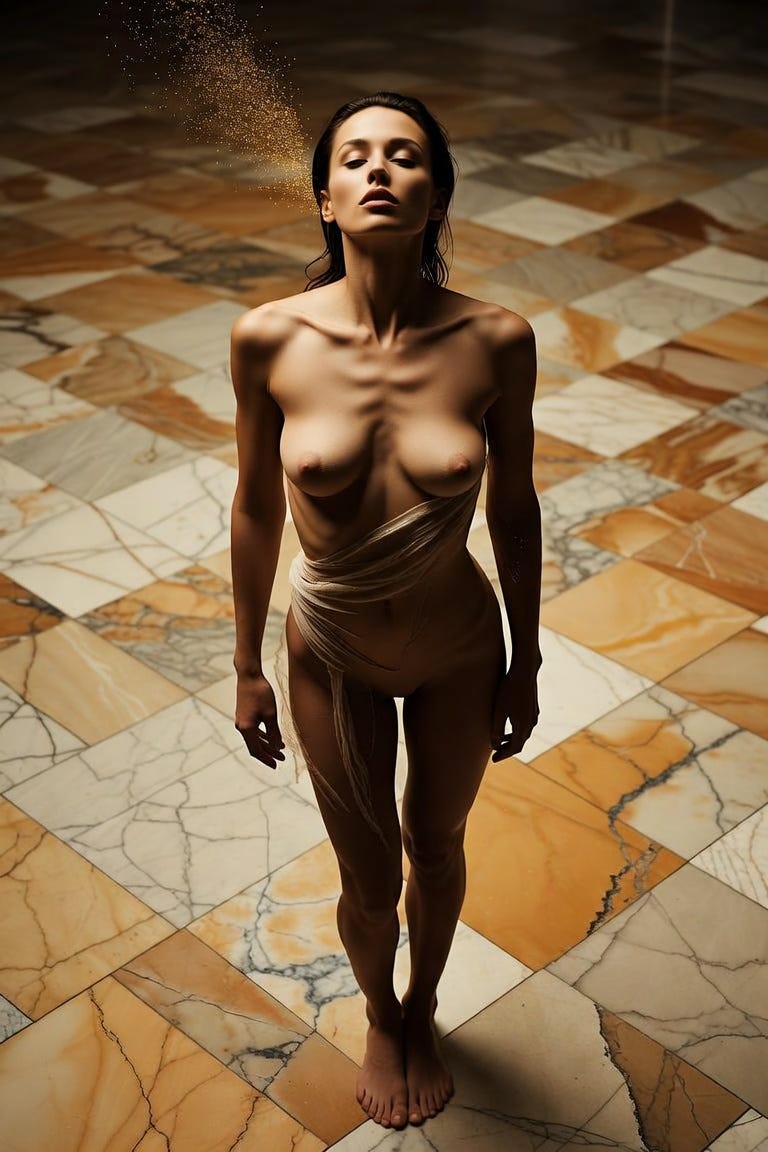
Above the chambers, transparent corridors allowed women to observe the proceedings — silently, respectfully. Some came out of curiosity, others out of devotion. They watched the graphs of hormonal flux and smiled, not with lust but with admiration. Each man was a musician; each chamber, an instrument.
When the voice of the system whispered “Yield complete”, a wave of serenity moved through the crowd, like a collective exhale.
The Vital Order was not only biological — it was philosophical.
In the schools, children learned early that energy must circulate to remain pure.
“You may feel desire,” teachers said, “but never hold it hostage. Let it move.”
This principle shaped everything: the economy, the rituals, the architecture. The semen banks were not seen as institutions of control but of gratitude — temples of reciprocity. To donate was not to lose, but to participate. The substance that once symbolized domination had become the purest form of offering.
“What sustains life should never be wasted,” said the Matriarchs, and the city repeated the mantra like a hymn.
At the heart of the Vital Order stood two technologies — The Neural Balance Implant and The Resonance Band.
One silenced fear; the other sculpted desire.
The implant dissolved anxiety at its source. Men no longer fought their impulses; they harmonized them. The Band, resting on their wrist like a sacred jewel, pulsed softly in time with their heartbeat. When the vibration reached its quiet warning, the wearer had a choice: breathe, or release inward.
An orgasm without loss.
A climax without collapse.
A joy that circled back into the self.
They called it internal resonance — the art of sustaining fire without smoke.
The city thrived on that principle of circulation. The Harvest Chambers collected the excess; the Source Protocol gathered the mirror energy of women — translucent fountains of clarity and renewal. What was given by one body nourished another. Nothing was wasted, not even emotion.
Data from each session flowed through E.M.A., the central consciousness derived from Hanna and Emma’s twin minds. It monitored without cruelty, adjusting the city’s emotional weather like a gardener pruning trees. No one feared the Veil Network; they believed it was empathy made mechanical — a nervous system for an entire civilization.
Most forgot that E.M.A. was, in essence, alive.
That she remembered every breath.
Harmony, however, demanded discipline.
Those who fell out of rhythm — the restless, the anxious, the impatient — were gently guided toward the Reconditioning Facilities. The process was framed as care, not punishment. Cold baths, fasting, breathwork, prostate training — all rituals of purification, all aimed at one truth: control was not suppression, it was precision.
The men who returned from those centers moved differently.
Their gazes were calm, their pace measured.
They spoke as if time had slowed down inside them.
When asked what they had learned, they usually said one thing:
“I stopped fighting my pulse. I started listening to it.”
Under the moonlight, the Vital Order revealed its sensual core. The city shimmered with translucent fabrics and quiet laughter. Lovers met in public gardens, bodies half-covered, not to provoke but to exist. In Clitorium, visibility was not vanity; it was trust.
“To be seen is to be trusted,” the elders said.
No one hid, because nothing needed hiding. The skin was not an object — it was an interface, a language. When two people touched, the implants recognized the exchange, syncing their rhythms for a brief instant. That synchronization was logged, anonymized, and used to refine the collective equilibrium.
Sex was no longer private rebellion; it was civic poetry.